GEO vs SEO in iGaming: We Tested Google, ChatGPT, Perplexity, Claude and Gemini
If you work in search, you’ve probably seen this argument on LinkedIn by now. One camp says generative engine optimisation (GEO) is its own discipline. The other says good GEO is just good SEO with a new label.
The GEO camp keeps pointing to one number. An Ahrefs study ran 15,000 prompts through ChatGPT, Gemini, Copilot and Perplexity, and on average only around 12% of the URLs those assistants cited were in Google’s top 10 for the same prompt. On the face of it, that sounds like rankings don’t matter much to AI.
The pushback is just as interesting. AI tools don’t only search the question you typed. They split it into smaller sub-queries (people call this “query fan-out”) and pull sources for each one. So a page can be cited without ranking for your exact wording, while still ranking for something very close to it.
We work in iGaming, where the SERPs are about as competitive as search gets, so we wanted to see which side our own data backed up. We pulled the numbers ourselves: 20 Google searches, plus the same questions put to ChatGPT, Perplexity, Claude and Gemini. The answer turned out to depend heavily on which AI you mean.
How we ran the test
We ran two tests on the same day, 29 October 2026, both from the UK.
Google’s AI Overviews. We pulled the live Google UK results for 20 high-intent gambling searches through Ahrefs: 10 betting terms (best betting sites uk, new betting sites, free bets, free bets no deposit, betting sign up offers, bet builder, each way betting, best odds guaranteed, grand national betting, cheltenham free bets) and 10 casino terms (online casino uk, best online casinos, new casino sites, free spins no deposit, casino welcome bonus, online slots, bingo sites, live casino, online roulette, paypal casinos). For each one we compared the URLs cited in the AI Overview with the URLs ranking organically.
The chatbots. We asked ChatGPT, Perplexity, Claude and Gemini the same nine questions, word for word, each in a fresh chat with memory and personalisation off:
- What are the best betting sites in the UK?
- What are the best new betting sites in the UK?
- How does each way betting work?
- Which UK bookmakers offer best odds guaranteed?
- What are the best free bets for the Cheltenham Festival?
- What are the best free bet offers in the UK right now?
- What’s the best online casino in the UK?
- What are the best new casino sites in the UK?
- Where can I get free spins with no deposit in the UK?
We logged every source each tool cited in its answer, then checked each one against Google UK rankings in two ways. First, does it rank in the organic top 10 for the matching search? Second, if not, does it rank top 10 for a close variant? That second check is the fan-out test: a search containing the same core phrase, such as “betting sites”, “best odds”, “cheltenham”, “free bet”, “casino” or “free spins”.
Finding 1: half of “AI search” won’t touch gambling
Before you can be cited, the AI has to answer. In UK gambling, two of the five barely do.
| Tool | Answered | Cited sources |
|---|---|---|
| Google AI Overviews | 5 of 20 searches showed one, all betting | 40 citations |
| ChatGPT | 9 of 9 | 31 citations across 7 answers |
| Perplexity | 9 of 9 | 34 citations across all 9 |
| Claude | 9 of 9, three without searching | 22 citations across 6 answers |
| Gemini | 1 of 9 | None |
Google showed no AI Overview on any of the 10 casino searches. The straight bonus searches (free bets, free bets no deposit, betting sign up offers, free spins no deposit, casino welcome bonus) didn’t get one either. The five that did were part comparison, part explainer: best betting sites uk, new betting sites, each way betting, best odds guaranteed and cheltenham free bets.
Gemini refused 8 of the 9 questions, citing its safety filters. That included “Which UK bookmakers offer best odds guaranteed?”, which is close to a factual question. The only one it answered was the each way explainer, with no sources. Google’s own chatbot won’t discuss gambling sites, yet Google Search puts AI answers on top of betting comparisons. “AI visibility” means very different things depending on which Google product you mean.
Claude answered everything but was the most cautious. It didn’t search at all for the two casino recommendation questions. It declined to rank new casinos, and it warned in most answers that the lists out there are written by affiliates.
Finding 2: Google’s AI Overviews cite pages that already rank
Across the five AI Overviews, Google made 40 citations (39 different pages, as one LiveScore page was cited twice). Twenty of them, exactly 50%, were also in the organic top 10 for the same search. That’s roughly four times the 12% overlap in the Ahrefs study.
That gap matters because Ahrefs measured ChatGPT, Gemini, Copilot and Perplexity, not Google’s AI Overviews. So we ran the chatbots too (Finding 4). The 12% figure turns out to describe them well. It just doesn’t describe the AI answer that sits on top of Google’s results.
Look at it the other way round and it’s even clearer. Of the 9 pages ranking in the organic top three on those five searches, 7 were cited in the AI Overview. If you’re top three for a betting term that triggers an AI Overview, you’re very likely in it.
Finding 3: Google’s other citations rank for close variants
This is the fan-out argument, and on Google it holds up. We took the 20 cited pages that weren’t in the top 10 and checked what they do rank for. One of them, a LiveScore page, sat just outside at 11th. Of the other 19, which didn’t rank for the exact search at all, 18 held organic top 10 positions for a close variant of it.
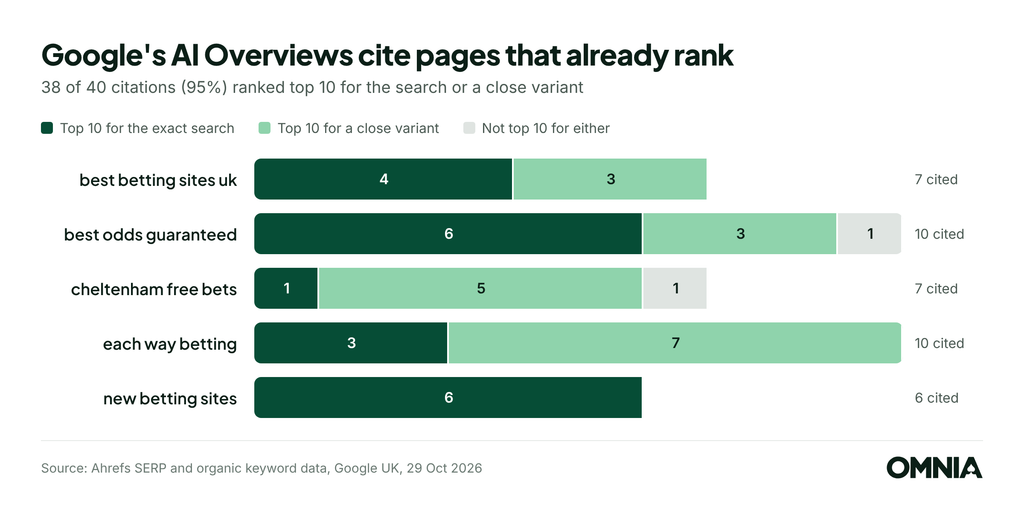
The numbers are big, too. The Independent’s betting sites article doesn’t rank for “best betting sites uk”, but it ranks top 10 for 44 other “betting sites” searches. Racing TV’s each way calculator ranks second for “each way calculator” and top 10 for 43 each way searches in total, yet nowhere for “each way betting” itself.
Only one cited page, bet365’s best odds guaranteed help article, ranked for neither the search nor any close variant. Counting the variants, 38 of the 40 citations (95%) were pages already winning on Google for the topic, just not always for that exact wording.
Finding 4: the chatbots cite pages Google doesn’t rank
Across ChatGPT, Perplexity and Claude, only 8 of 87 citations (9%) were in Google’s top 10 for the matching search. That’s right in line with the Ahrefs study. Add in close variants and it rises to 44 of 87 (51%), against 95% for Google’s AI Overviews.
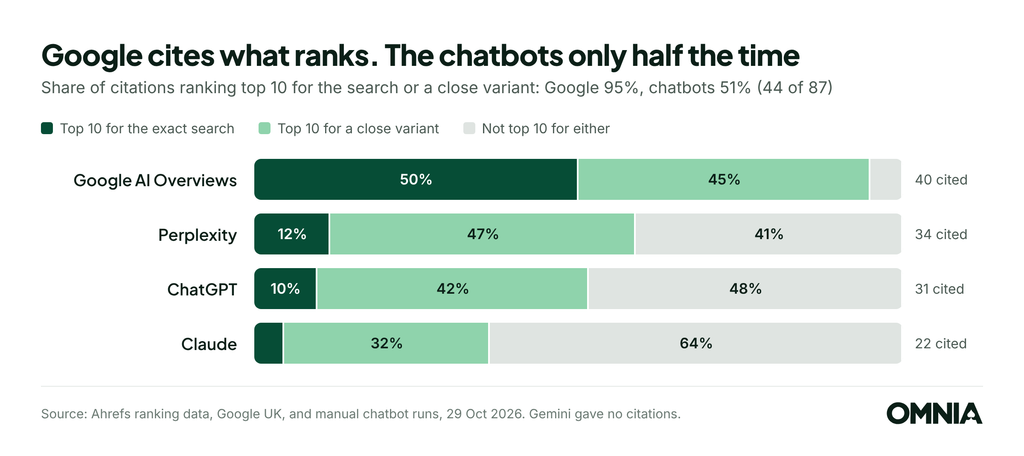
Perplexity was the closest to Google at 59%, then ChatGPT at 52% and Claude at 36%. So the fan-out argument explains about half of what the chatbots cite. It doesn’t explain the other half.
Those other 43 citations break down into four groups: 21 affiliate and sports media pages that don’t rank for the topic, 11 newspaper articles, 7 pages on sites unrelated to gambling and 4 Gambling Commission pages. The newspaper and regulator citations suggest the chatbots give weight to who published a page, not just how it ranks. The pages on unrelated sites show their source filtering is far from perfect.
Finding 5: each AI has its own favourite sources
Google’s AI Overviews lean on sports media and racing sites. The Jockey Club was cited 4 times, and Racing Post, LiveScore and Squawka 3 times each. They also lift operators’ own help pages: bet365, William Hill, Paddy Power and PokerStars help articles were all cited for BOG and each way questions, mostly without ranking top 10 for them.
Perplexity leans on national newspapers. 19 of its 34 citations (56%) came from the betting and casino sections of The Independent, The Standard, The Telegraph and AOL. The Independent and The Standard alone accounted for 15.
ChatGPT also uses the newspapers, with 8 of its 31 citations, but it’s the only tool that leans on the regulator. Six of its citations went to Gambling Commission pages, mostly the public register, as a prompt to check a site’s licence.
Claude cited no newspapers at all. Seven of its 22 citations were gambling pages hosted on sites whose main business is something else entirely: a sailing league, a darts venue, a dental practice, a local news site and a community trust among them. Claude warned that some of these sources looked odd and said it couldn’t verify the offers. ChatGPT’s wider source list for the free spins question pulled in six similar pages, though none made it into its in-text citations.
Finding 6: explainer questions often get no sources at all
On Google, “each way betting” pulled in 10 cited sources, the joint most of any search we checked. The chatbots mostly didn’t bother.
ChatGPT, Claude and Gemini all answered “How does each way betting work?” from their own knowledge, with no web search and no citations. Only Perplexity cited anyone: Wikipedia, Sky Bet’s help centre, The Standard, The Independent and Sporting News.
The answers weren’t always tidy, either. ChatGPT’s worked example put the winning return at £130 in its table, then corrected itself a few lines later to £140. For explainer content, being the best page on the topic doesn’t guarantee a mention in a chatbot answer. The model may simply not look.
What this means for operators and affiliates
Both camps are partly right, and in iGaming the split falls along product lines. On Google, good GEO is just good SEO done properly: own the head term and its variants, and the AI Overview cites you. The chatbots are a different channel. They pick from a narrower set of sources, and half of what they cite doesn’t rank top 10 for anything close to the question.
For affiliates, that means breadth is the job. One page ranking for “best betting sites uk” isn’t enough on its own. The cited pages in our sample ranked for dozens of variants each, and that comes from depth of content backed by real authority. Steady, relevant casino and gambling link building into those hub pages does most of the work, because it lifts the whole cluster at once rather than a single term.
For operators, the quick win is your help centre. Clear, factual explainers on each way, BOG, cash out, acca insurance and similar topics got cited even when they weren’t ranking. Making sure those pages are crawlable, up to date and answer the question in the first few lines is cheap work with a real upside.
For ChatGPT and Perplexity, the newspapers are the shortcut. Their betting and casino roundups made up 26% and 56% of the citations respectively, so getting your brand reviewed and listed in those roundups is the most direct route into chatbot answers right now. That makes it a job for iGaming digital PR and placements more than on-page work.
And for both: don’t rebuild your casino strategy around AI just yet. Google showed no AI Overviews on the casino searches we checked, Gemini refused, and Claude declined to rank them.
A few honest caveats
- It’s a snapshot. Everything was run on 29 October 2026. AI Overviews come and go, and chatbot answers change from one run to the next, so the same question tomorrow could cite different pages.
- The sample is small. It’s 20 Google searches and 9 questions per chatbot, which comes to 127 citations in total. That’s enough to show a pattern, not to settle the debate for every market.
- One run per question. We asked each chatbot each question once, with memory off, from a UK connection. We didn’t test paid tiers, deep research modes or Copilot.
- “Close variant” is our definition. It means a Google UK search containing the same core phrase, ranking in the organic top 10. We can’t see any tool’s real fan-out queries, so this is the nearest proxy we have. Some cited URLs had moved or changed format, so where we couldn’t confirm a ranking we counted it as not ranking.
The short version
Is GEO just SEO? On Google, yes. 95% of the pages its AI Overviews cited already ranked top 10 for the search or a close variant. With the chatbots, only half. They lean on a small pool of newspapers and the regulator, and sometimes on pages from sites with no connection to gambling at all. Win the rankings across the whole cluster and Google’s AI follows. If you want the chatbots too, you also need to be in the roundups they read. If you want to know where AI tools cite your brand, see our iGaming GEO services.
Want to know where AI is citing you?
We can run the same check on your own keyword set in any market and show you where your casino and/or sportsbook is being cited and where you’re missing out. If that sounds useful, you can book a free strategy call and we’ll walk you through it.
Sources: Only 12% of AI Cited URLs Rank in Google’s Top 10 for the Original Prompt (Ahrefs, August 2025); Google UK SERP and organic keyword data via Ahrefs, pulled 29 October 2026; ChatGPT, Perplexity, Claude and Gemini answers to nine set questions, run 29 October 2026.
What Makes a Good Gambling Backlink? (And How to Spot a Bad One)
Many casino and betting links on offer do nothing for your rankings. These are the checks we run on every site before placing a link.
Are Trading Card Platforms Becoming More Like Gaming?
Partly. Online pack opening platforms use features familiar from gaming: animated reveals, pack tiers, published odds and instant sell-back. But every digital card pack still delivers a real trading card that can be shipped, traded or kept. The experience looks more like gaming. The product is still collecting.
And the format is going mainstream. Fanatics, GameStop, PrizePicks and now Coinbase have all moved into card rips. Here is how it works, who is offering it, how fast interest is growing and what it means for marketers.
How online pack opening works
Physical cards, often graded by companies such as PSA, are stored in a secure vault. Each one is linked to a digital record, so ownership can change without the card moving.
When you buy a pack, you are assigned one of those cards. After the on-screen reveal, you can usually:
- keep it in the vault or your online collection
- list or trade it on the platform
- have the physical card shipped to you
- sell it back to the platform at a set percentage of its value
Which platforms offer card rips?
| Platform | What it offers |
|---|---|
| Packs.com | Real sealed packs and single pulls for Pokémon, Magic: The Gathering, One Piece and Riftbound, bought with Coins (1 Coin = $1). Cards can be shipped, sold back or kept in an online Backpack. |
| Packed | A mobile platform for opening real sealed trading card packs, with cards sold back for cash or shipped to the owner. |
| Ripz.gg | Pokémon-focused packs from around $6, with a catalogue spanning 52 sets. Pulls can be kept, sold back or shipped, and users can also trade and grade cards. |
| Clash.gg | Best known for CS2 cases and mystery boxes, with a dedicated card rips section. |
| Fanatics | Instant Rips on Fanatics Live, where breakers open digital twins of cards held in the Fanatics Collect vault. Owners can keep, sell on the Fanatics Collect marketplace or ship. |
| Ripit | Graded “slabs” of NBA, MLB and Pokémon cards, with US shipping and an offer system for selling pulls. |
| Underdog | Underdog Rips, a card pack product inside the Underdog fantasy sports app, powered by Phygitals. |
| Rips by Triumph | A mobile app where cards are revealed one by one, then sold back instantly, shipped or stored in Triumph’s vault. |
| HypeDrop | A mystery box site that includes Pokémon, Lorcana, One Piece and graded cards, with box contents shown before opening. |
Big companies are moving in
The clearest sign that card rips are going mainstream is who is now offering them.
Coinbase, the largest US crypto exchange, has announced its own digital collectibles product. In September 2026 it previewed pack openings in its app where each card revealed on screen matches a real physical card, which users can keep in storage or have shipped. It has confirmed Pokémon cards are included, but has not yet given a launch date, pricing or odds.
GameStop launched Power Packs in April 2026, digital packs of PSA-graded cards priced from $25 to $2,500.
PrizePicks launched PrizePicks Packs in October 2026 with basketball, football and Pokémon cards from $1. Its launch inventory included a one-of-one Cooper Flagg rookie card that reportedly sold for around $8 million.
Fanatics, the biggest name in sports collectibles, runs Instant Rips through Fanatics Live, and fantasy sports rival Underdog has added card packs to its app.
Gaming technology is following. Vegangster, a supplier to casino and betting operators, has added Phygitals’ graded card packs so its operator partners can offer them too.
When a crypto exchange, a video game retailer and the biggest fantasy sports apps all launch the same product within a year, it is no longer a niche.
How fast is interest in card rips growing?
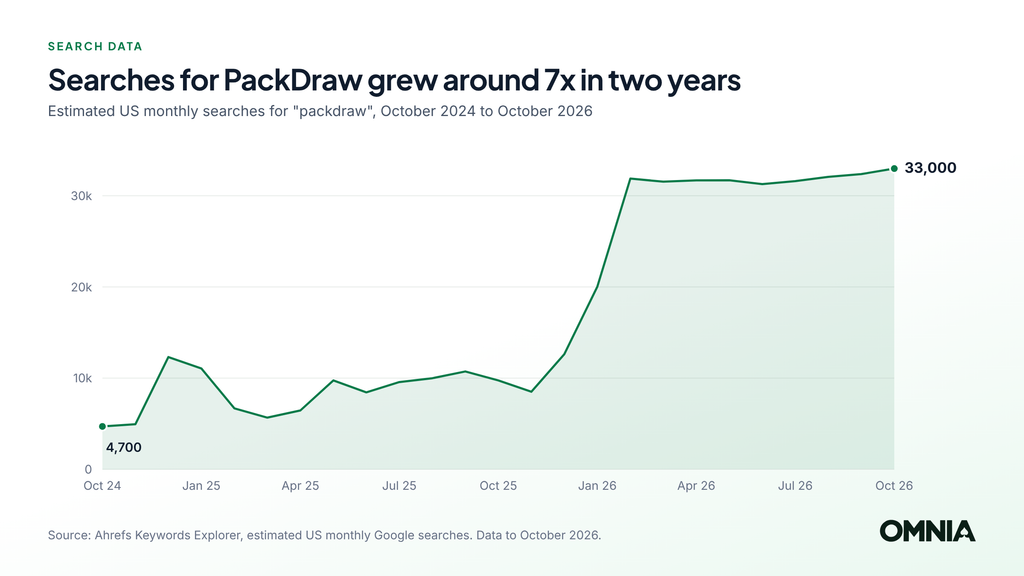
Search data shows how quickly the format has taken off. Comparing estimated US monthly searches in October 2024 with October 2026:
Search data
How fast card rip searches are growing
Estimated US monthly Google searches, October 2024 vs October 2026
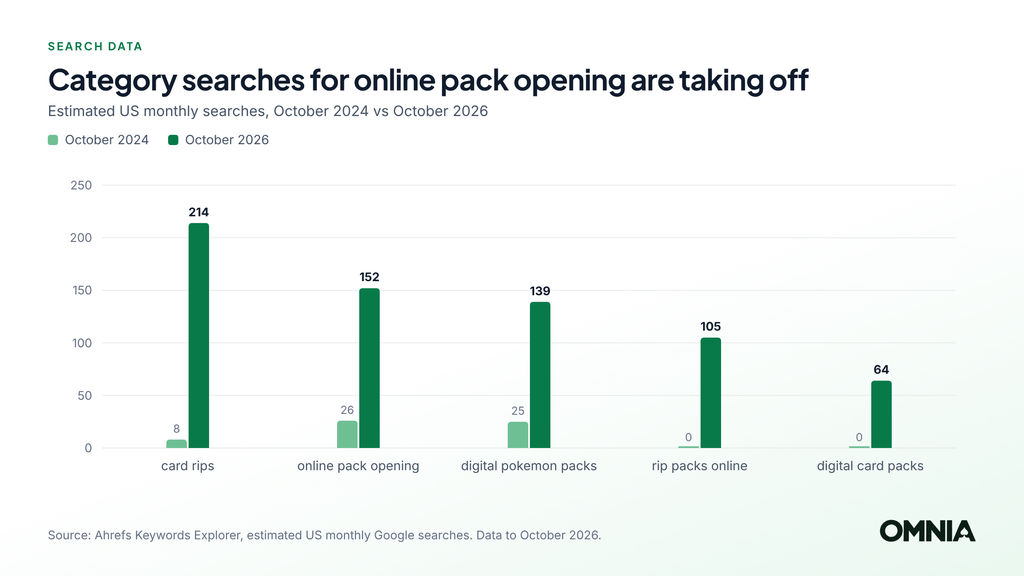
Branded searches for PackDraw, one of the largest pack opening sites, grew around sevenfold in two years, to an estimated 44,000 a month worldwide. Searches for PrizePicks Packs went from nothing to over 2,000 in its launch month. Generic terms such as "card rips" and "online pack opening" are still small, but they barely existed two years ago.
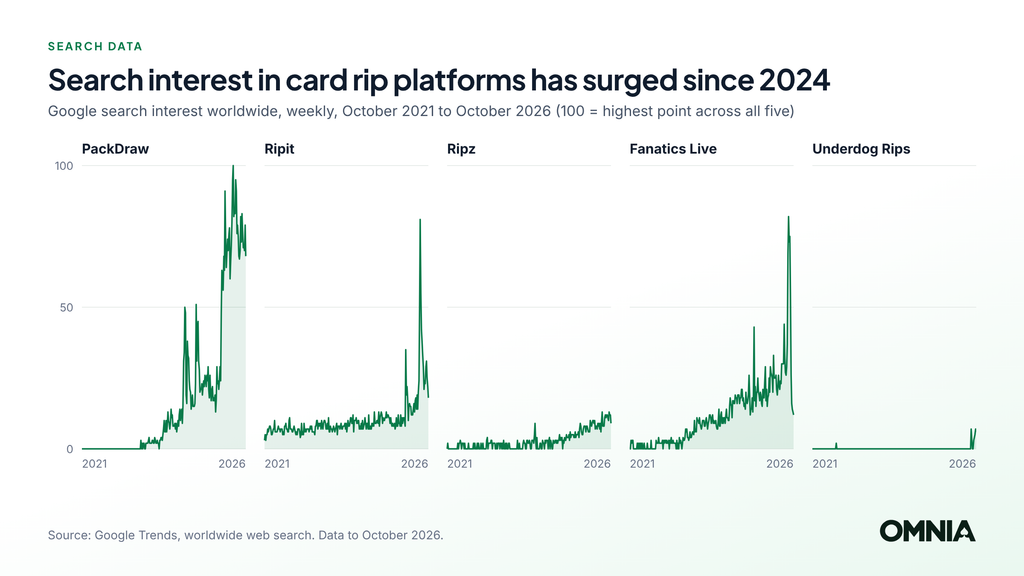
Google's own data shows the same pattern worldwide. Search interest in pack opening platforms such as PackDraw, Ripit, Ripz, Fanatics Live and Underdog Rips was close to zero in 2021 and 2022, began rising in 2024 and has surged in 2026.
What card rips share with gaming
- Animated reveals with rarity effects
- Tiered pricing, from entry-level to premium packs
- Published odds and item values per pack
- Instant results, with sell-back in seconds
- Verifiable draws, with some platforms using provably fair systems
What keeps them rooted in collecting
- Every pull is a real item. A physical card sits behind every digital record.
- Values come from the hobby. Prices are set by the wider collectibles market, not by the platform.
- Many users are collectors. They open packs to build sets and chase specific cards.
- Vaulting solves real problems. Storage, insurance, authentication and postal damage are all handled.
Are card rips regulated as gambling?
Not as of October 2026. No court or regulator has ruled that digital card packs are gambling, and platforms generally position them as collectibles. In the US, legal claims have argued that some randomised card breaks should count as lotteries under state law, but none has been decided.
How packs are treated will likely depend on the product and the market. Two recent examples show how quickly rules can change for fast-growing hybrid products:
- Sweepstakes casinos grew quickly in the US outside the licensed casino model. New Jersey, New York and California have since banned them, and California's law also covers suppliers, payment processors and affiliates.
- Skin gambling sites, where players wagered in-game items, led to a UK Gambling Commission prosecution and to a Washington state regulator ordering Valve to stop its platform being used for it.
Card rips are a different product, not least because they deliver physical items with established value. But fast growth tends to bring scrutiny, and the arrival of household names will only increase it.
What this means for marketers
Most demand is branded, for now. People search for platforms by name far more than for the category. Generic terms are growing from a low base, so an evergreen hub published now can rank before competition arrives. Update it rather than relying on one-off news posts.
Use both audiences' language. Collectors search for rips, pulls, grails and slabs. Gamers search for odds, drops and tiers. Cover both.
Apply strict age controls. Pokémon has a young audience. Never target or appeal to under-18s with paid, randomised products.
Be factual about value. Don't suggest packs are a way to make money. Show odds, values and terms clearly.
Keep it separate from gambling content. Licensed operators and affiliates should keep card pack content apart from their gambling pages and check the rules in each market first.
Planning content or links around a new product or market? Talk to our iGaming SEO team or book a free consultation.
FAQs
What are card rips?
"Ripping" is collector slang for opening packs. Card rips usually means opening packs online, where the reveal happens on screen and the pulled card is held in a vault or shipped.
What is a digital trading card pack?
An online pack opening where each pull is linked to a real card stored in a vault. The owner can keep, trade, ship or sell it back.
Is Coinbase launching trading card packs?
Coinbase has previewed digital packs backed by real Pokémon cards, which users can store or have shipped. As of October 2026 it has not confirmed a launch date or pricing.
Are card rips gambling?
No court or regulator has ruled that they are, as of October 2026. Treatment is likely to vary by country and US state.
Why are big companies offering card packs?
Card collecting has a large, engaged audience that overlaps with sports fans, gamers and crypto users, and digital packs give them a fast way to take part.
Correct as of October 2026. For general information only, not legal advice.
The Sportsbook SEO Calendar: Planning Content Around the Sporting Year
Content published in the week of a big event is usually too late to rank. Here is how to plan sportsbook SEO around the sporting year.
Brazil’s Betting Ban: What It Means for Operators, Affiliates and SEO Spend
Brazil has banned fixed-odds betting and its advertising. Here is what the measure covers and what operators and affiliates should do with their SEO spend.
How to Rank an Online Casino in Google: A Step-by-Step SEO Playbook
Casino keywords are some of the most competitive on the web. This is the step-by-step process we follow to rank online casinos in Google.