

Greece’s Online Betting Market Is Growing Faster Than People Realise
Greece does not get talked about the way Sweden, the UK or Germany do when the conversation turns to regulated iGaming. It should. The latest figures from the Hellenic Gaming Commission tell the story of a market that is growing, digitising fast, and tightening its regulatory grip all at once. For operators and affiliates weighing up where to put their next wave of investment, that combination is worth a close look.
We work in this space every day, running link building, outreach and content campaigns for regulated betting and casino brands across Europe. So when a market starts moving the way Greece is moving, we pay attention. Here is our read on the numbers, what is driving them, and where the opportunity sits.
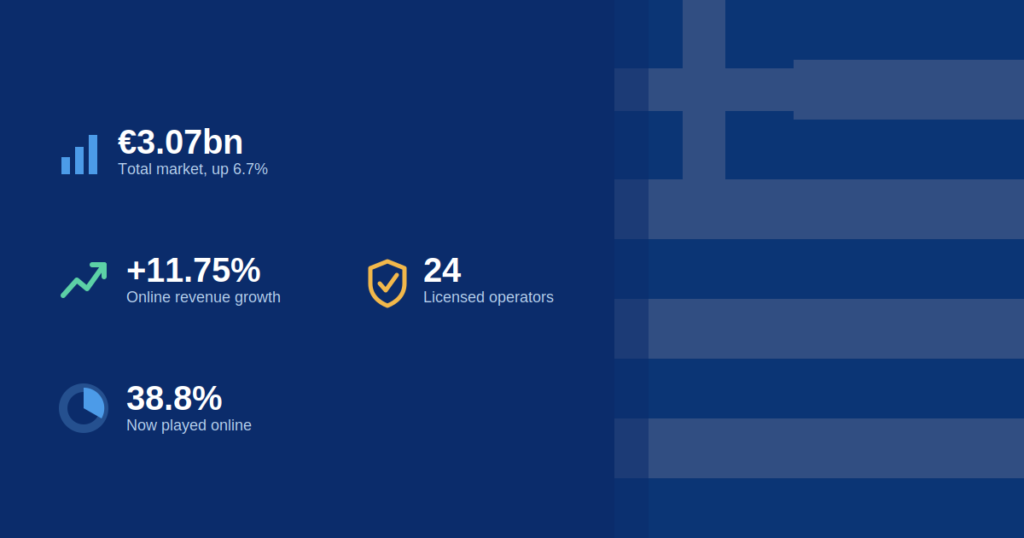
Greece's gambling regulator released its 2025 annual report in July 2026, and the top-line figures set the scene. The regulated market generated gross gaming revenue of €3.073billion last year, up 6.74% year on year. That growth was not evenly spread. Online revenue grew 11.75% across the year. Land-based grew just 3.8%. Remote gambling now accounts for 38.79% of the entire market, up from a smaller share the year before. Land-based still holds the larger slice at 61.2%, but the direction of travel could not be clearer. Digital is where the momentum is. The state benefited too. Gambling contributed roughly 1.17 billion euros to the Greek budget in 2025, an 11.2% increase year on year, with online operators alone contributing the largest chunk of that figure. A growing, taxable, regulated market is exactly the kind of environment that governments protect and operators can build inside with confidence.
Brands Running The Market
The competitive picture is defined by strong domestic brands. Stoiximan, now fully owned by Greek gaming group OPAP following OPAP’s acquisition of the remaining stake from Kaizen Gaming in mid-2025, remains the clear market leader in online sports betting and casino, holding around half of the licensed online sports betting market.
Novibet, part of the Allwyn group, sits in second position with a share in the region of 19 to 20%. International operators including Bet365, Bwin and Betsson hold smaller but meaningful positions. Kaizen Gaming, the Greek-founded operator behind the Betano brand, has pivoted its focus to international expansion following the Stoiximan divestment, which tells you something about how globally competitive Greek operators have become.
What matters for anyone entering the market is this: domestic incumbents are strong, but the field is not closed. With 24 licensed online operators live and more working through the licensing process, there is real competition and real room to win share, particularly among higher-value players where competition is more limited than in saturated Western European markets.
What Is Driving Growth?
A few forces are pushing Greek iGaming forward at once.
Sports betting sits at the centre of it. Greeks are passionate about football, and that enthusiasm translates directly into betting activity. Sportsbook is the anchor product for most operators in the market, and major sporting cycles amplify it further.
Demographics help too. The regulator noted that people aged 25 to 34 and 45 to 54 make up a disproportionately high share of online gamblers relative to their weight in the general population. That gives operators two distinct and valuable audiences: a digital-native younger cohort comfortable with mobile-first play, and an older, often higher-value group with more disposable income. Those two groups demand very different acquisition and content strategies, which is where a market-specific approach earns its keep.
Underlying all of it is a structural shift toward mobile. Rising smartphone adoption, better digital payment options and evolving player preferences continue to move activity onto phones and away from betting shops. Live dealer casino games are also gaining traction, offering the immersive experience that keeps players engaged for longer.
Regulation
The best things to do outside of work are prioritising things you enjoy, most people who are stressed at work do activities like seeing friends, doing exercise or going on a hike.
In order to rank competitively in any international market for gambling, you need backlinks. The most important reason is because each backlinks is a trust signal to Google. The more authoritative the website is that is referring you, the more power and influence that backlink has. Which is why we target high quality mentions.
Capitalising on SEO Now
Here is the part that most market overviews skip. A growing, tightening, digital-first market like Greece changes the economics of search and content, and operators who move early on organic have a structural advantage.
When enforcement removes illegal operators from the equation, organic search demand consolidates around a smaller pool of licensed brands. The players are still searching. The question is who ranks when they do. In a market still maturing in terms of digital sophistication, the brands that invest early in authoritative content and a strong, relevant backlink profile lock in positions that become far more expensive to challenge later.
Greek-language content is a genuine moat. This is not a market you win by translating your UK pages and hoping. It rewards operators who build real topical authority in Greek, target the sports and casino terms that local players actually use, and earn links from relevant, trustworthy Greek and international sources. Sports betting content in particular, tied to the football calendar and major tournament cycles, is where a lot of the highest-intent search volume lives.
And because the regulator is watching closely, compliance-aware content and outreach are not optional. Responsible gambling messaging, correct licensing signals and clean, defensible link building are what keep a brand safe while it scales. This is exactly the kind of regulated, high-scrutiny environment where a specialist partner matters more than a generalist agency.
Greece offers strong growth, EU-aligned regulatory stability, a decisive shift to digital, and a regulator actively clearing the market of illegal competition. It is less crowded than the mature Western European jurisdictions, and the operators who build organic visibility now will own it for years.
That is a rare combination, and the window to establish authority is open right now.
Work With A Specialist iGaming SEO Partner
At Omnia, iGaming is what we do. We run link building, guest post outreach and content production for regulated betting and casino brands across the UK, Ireland and European markets, with deep experience navigating the compliance requirements that come with regulated verticals. If you are an operator or affiliate looking to build organic visibility in Greece, or across Europe, we can help you do it properly and defensibly.
Get in touch with the team at omniaagency.co to talk about your Greek market strategy.

Does Domain Authority Matter in SEO?
Anyone who’s spent enough time in SEO will have come across Domain Authority (DA) before. You’ll find it in nearly every single SEO report, audit, analysis, link sheet, etc.
But what does it actually mean? And should you be prioritising it in your SEO strategy?
What is Domain Authority?
Domain Authority is a metric that was developed by Moz, a popular third party SEO tool. Similar SEO tools use this same metric, sometimes with a different name and calculate it slightly differently too. For example, ahrefs.com has a Domain Rating metric.
A website is given a DA score between 1-100. The higher the number, the more authority the website is said to have and therefore the more likely it is to rank in search engines. Not only that but rank competitively for difficult terms.
DA is calculated based on the following:
- The number of linking root domains
- The quality and relevance of backlinks
- Website structure and SEO health
It is important to mention that DA is NOT a Google metric and is only used by third party tools for SEO purposes.
Does Google Use Domain Authority?
No. Google does not use the metric Domain Authority as a ranking signal.
There are over 200 ranking factors in Google’s algorithm and Google’s John Mueller has stated that Google does not consider DA.
Domain Authority is simply used as a relative measure, particularly for SEOs like ourselves when doing competitor analysis against websites ranking for keywords we are targeting. Typically if a website has a higher domain authority, it is worth checking out their SEO, including backlink profile and overall site health to see what can be replicated or further improved for our client’s sites.
Why Does it Matter?
As mentioned it is not a Google ranking factor, so why does it matter at all? Well, it does hold value in SEO.
You can see how your website stacks up against competitors. For example, let’s say we have a client wanting to rank for the term “online casino” with a Domain Authority of 5, we will explain to them that this would take a considerable amount of time and investment, considering right now as I’m writing this, here are the Domain Ratings of the Top 10 competitors in the US for the term “online casino”, according to ahrefs.com: 73, 80, 82, 70, 75, 77, 96, 74.
Client Case Study Example
We have been working with a client in the gambling industry to improve their SEO through link building. This client is already authoritative in the gambling industry, having been around for a long time and actually has gambling shops across the UK.
They came to us as they wanted to outsource their link building to a specialised iGaming SEO agency. Having seen that this company was already an authoritative brand, without maximising their SEO, we knew we could get results quickly.
Below, you can see an image which shows the quick improvements in clicks and impressions for our client, over the last 6 months, compared against the 6 months prior to when we started building backlinks for them. It is also important to mention that this is for non-branded keywords only.
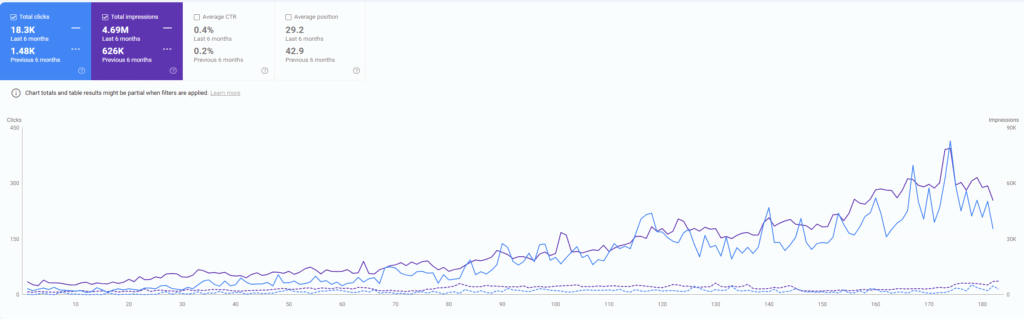
One of the main reasons as to why this happened, apart from doing extensive research to find high quality, relevant link building opportunities, was because they already had authority in this industry.
This proves that whilst Google does not use Moz’s metrics or any other third party tool in its ranking algorithm, it does consider Authority as a trust signal, leading to better rankings.
Domain Authority Can Be Fabricated?
Firstly it is important to mention that Google does consider genuine authority. For example if your website has trust signals from other very high quality sources, this will certainly benefit your website. However, third party SEO tools, like Moz, can fall victim to fabricated metrics, Domain Authority being one of them.
One of the main aspects that DA is calculated from is the backlink profile of the website. The more backlinks a website has, typically the higher the DA. Of course quality beats quantity but you can still gain a relatively high DA from lots of backlinks, even if most of them aren’t genuine, trusted websites.
This can skew the data on SEO tools, leading to a website seemingly having a strong DA score, but when you delve deeper into their backlink profile, you find that there aren’t any links from genuine, trusted sources and it is full of “spam” sites and link farms.
This is one of the main reasons why Domain Authority alone is not a metric to go off when building links and it should be considered alongside other metrics such as referring domains, trust score, keywords, organic traffic, niche and more.
Different Tools, Different Score
Another important reason as to why Domain Authority alone is not enough to go off when finding link opportunities is because different tools use different scores. Ahrefs uses Domain Rating (DR), Semrush has Authority Score, Majestic has Trust Flow. Each uses different algorithms.
It also doesn’t reflect the quality or intent. It’s not always the case that a higher DA means better rankings as you will find lower DA sites ranking higher based on the quality of the site overall and the intent.
So, Does Domain Authority Matter?
Yes – but only in context.
As a standalone metric, Domain Authority is not enough to indicate the quality of a website and should be taken into consideration alongside other important metrics and ranking signals that Google have confirmed to us.
Whilst it is the case that genuine high quality websites will represent a strong DA score, you will also find that other websites, of much lesser quality can fabricate their metrics and share the same DA score through other blackhat techniques.
When mapping out an SEO strategy for your website or one of your client’s websites, use DA, DR or other similar metrics from various SEO tools as a guide and not as a definitive goal.
Stress Awareness Month 2024: 54% of Employees Are Stressed At Work
Stress Awareness Month 2024 takes place throughout April. Research conducted by Omnia Agency provides insight into the stress at work statistics, using data from a Lattice poll, to determine what both companies and employees can do to help manage stress levels and ways in which they can de-stress both inside and outside of the workplace.
It’s worrying seeing the increasing number of people experiencing stress inside the workplace. 54% of people are stressed at work with 11% reporting that the stress was significant and taking a toll on their work and life. Companies and organisations need to be doing more to support their employees.
Ben Trainor - SEO Account Manager | Omnia Agency
How Stress Is Affecting Different Age Demographics
The data shows that those under 35 are the most stressed age group with 32% being burnt out at work in their current role.
Over 55s are less stressed than under 35s and a reported 8% of under 35s reported their stress as significant.
With 6% of those over 55s being significantly stressed and 14% of those under 35s being significantly stressed.
Reported Factors That Help De-Stress In Work
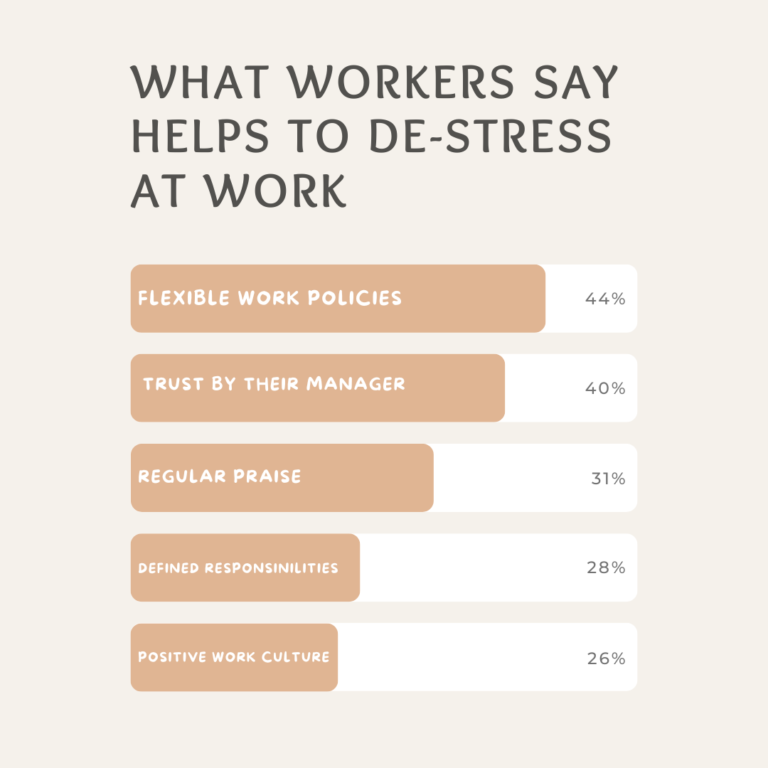
According to Lattice Poll, the best things to do to de-stress at work are:
- Flexible work policies (44% of people said this)
- Trust by their manager (40% of people said this)
- Regular praise (31% of people said this)
- Defined responsibilities (28% of people said this)
- Positive work culture (26% of people said this)
Stress Coping Mechanisms Outside Of Work
The best things to do outside of work are prioritising things you enjoy, most people who are stressed at work do activities like seeing friends, doing exercise or going on a hike.
How Managers Affect Work Stress
It is reported that 42% of employees feel that their employer does not believe their stress will affect their work.
Also, according to Lattice Poll, 38% of employees believed their employer did not care about their stress levels.
What Can Managers Do To Reduce These Numbers?
Managers can positively affect stress with understanding, realistic targets and positive feedback.
However, it is important to mention that managers are also experiencing high levels of stress, with 35% of managers or team leaders being stressed at work, and 42% of this being stressed because of the stress they put on themselves, according to Forbes.
What Can Organisations Do To Reduce These Numbers?
Ben believes that big organisations should have their own HR department that shows interest in their employees. Perhaps adopting new in-house strategies like weekly meetings or emails to employees that they can fill out, describing how they feel.
For example, the form could include a chart with different stress level percentages and employees can highlight which level they believe they are at currently those who are highly stressed can then be contacted by managers and other hierarchy where they can discuss the reasons for their stress and come up with solutions to reduce this.
Does Domain Age Impact Rankings?
For many years, SEOs have been under the impression that aged domains (domains that have existed for some time) can have a better chance of ranking compared to fresh (new) domains.
Buying domains that are listed for auction or even expired and building them out again has been a popular technique in the SEO industry, as they want to skip past the “Google sandbox” and see immediate, better rankings with a domain that has already existed in the SERPs.
But, what did Google have to say about this?
Google's Response About Domain Age
Well, John Mueller, from Google, was asked the following on X.com (formerly Twitter):
“Does the age of a domain name impact Google search rankings?”
In response to this, he said:
“No, domain age helps nothing.”
He also had a slight dig at domain autioners by mentioning that aged domains really only matter for those who want to sell you aged domains!
Is "Domain Age Ranking Impacts" Therefore A Myth?
It would seem that way.
Whilst Google and other search engines have access to data like domain age, they have stated in this instance that it is not a ranking factor. This means that as long as all the fundamentals of SEO are implemented correctly and you have a quality website to showcase to users, you should still have the same successes with a fresh domain.
Does This Mean You Should Stop Buying Aged Domains?
No, not at all.
Whilst what John Mueller said may well be true, there are still other benefits to buying aged domains.
Trust and Credibility
Older domains can be seen as more trustworthy and credible by search engines. This is based on the idea that a domain that has been around for a longer time is less likely to be a spammy or low-quality site. However, this is just one of many factors considered.
This is not to contradict what Google have said. What we believe could be true is that if a domain has ranked previously for keywords that you want to target, you may find it easier to rank for these terms again, with the help of other SEO ranking factors that we know are for certain, like quality content.
Historical Data and Backlink Profile
Older domains usually have more historical data and potentially a more robust backlink profile. Search engines use backlinks as an indicator of a website’s authority and relevance. A long-standing domain might have accumulated valuable backlinks over time, which can positively affect rankings.
Content Maturity
Older domains might have more content and have had more time to mature in terms of SEO. This means they could have a wider range of keywords they rank for, more indexed pages, and potentially more traffic – all positive signals to search engines.
How Long Does It Take To Rank A New Website With SEO?
Ranking a new domain in SEO can vary significantly based on several factors, and there’s no one-size-fits-all answer. Generally, it might take anywhere from several months to a year or more to see significant ranking improvements for a new domain.
For example, if you have a website that is simply a blog, providing information on topics that are not really going to affect people’s lives, like “celebrity net worth” or a “sports blog”, then as long as you tick all the right boxes and have a good quality site, you can see rankings quite quickly.
However, if your new website is trying to compete in more competitive niches, especially YMYL (Your Money Your Life) niches, such as gambling, finance, health, etc. then it will take a lot longer for your domain to gain significant rankings as Google is skeptical about showing this information from a brand new site to users.
This may be when you look to use a domain that has already got authority in these niches and has some evidence of trust from search engines.
But nothing is guaranteed in SEO and there is nothing stopping you at some point down the line surpassing sites that have been around a lot longer if the experience you can offer users is deemed better than other sites you are competing against for keywords and ranking positions.
Conclusion: Domain Age Is Not As Important As SEOs Once Thought
Based on the information provided by Google themselves, we can conclude that domain age being a ranking factor is in fact a myth.
However, let us not forget that there are case studies that suggest otherwise as other SEOs have tested this in the past, but like with any ranking factor in SEO, the exact significance of it cannot be proven.
All we can do is take Google’s word for it, but don’t let this stop you buying an aged domain that suits your products/ services. You could also benefit from the backlinks and content that the domain already has.
What we can do is not worry too much about domain age when analysing the SERPs and not let an older domain that is ranking well put you off from competing against them for rankings. Instead of worrying about this, focus your efforts on improving your site in every way possible and offering users a bespoke experience.
Understanding the Impact of Voice Search on SEO
In the ever-evolving landscape of digital marketing, voice search has emerged as a game-changing element. With the rise of smart speakers and virtual assistants like Amazon’s Alexa, Apple’s Siri, and Google Assistant, the way users interact with search engines is undergoing a significant transformation. This shift presents new challenges and opportunities for Search Engine Optimization (SEO). In this article, we delve into the impact of voice search on SEO and how businesses can adapt their strategies to stay ahead.
The Rise of Voice Search
Voice search is not just a trend; it’s becoming a fundamental aspect of daily online interactions. According to a recent study, a significant percentage of internet users now use voice search or voice commands daily. This change in user behavior is largely driven by the convenience and efficiency of voice-activated searches.

How Voice Search Changes SEO
Conversational Keywords
Voice searches are typically more conversational and natural-sounding than typed queries. This means businesses need to optimize for long-tail keywords and phrases that mimic how people naturally speak. For instance, while a typed search might be “best Italian restaurant NYC,” a voice search might be “What is the best Italian restaurant in New York City?
Local SEO Becomes More Crucial
Voice search is often used for finding local businesses or services. Phrases like “near me” or questions about local business hours are common. This trend underscores the importance of a robust local SEO strategy, including accurate and updated Google My Business listings.
The Importance of Featured Snippets
Voice search is often used for finding local businesses or services. Phrases like “near me” or questions about local business hours are common. This trend underscores the importance of a robust local SEO strategy, including accurate and updated Google My Business listings.

Adapting Your SEO Strategy for Voice Search
Focus on Natural Language and Question-Based Content
Create content that answers questions directly and conversationally. Use tools to understand the typical questions asked by your target audience and structure content around these queries.
Improve Local SEO
Ensure that your business is listed accurately on online directories and Google My Business. Encourage customers to leave reviews and keep your local content up-to-date.
Optimize for Mobile and Speed
As most voice searches are done on mobile devices, having a mobile-optimized, fast-loading website is crucial. Google’s mobile-first indexing means the mobile version of your site is the starting point for what Google includes in their index.
Structured Data Matters
Use schema markup to help search engines understand the context of your content. This can increase the chances of your content being used as a response in voice searches.
Conclusion
Voice search is not just a fleeting trend – it’s reshaping the SEO landscape. By understanding and adapting to the nuances of voice search, businesses can not only maintain but enhance their online presence. As technology continues to evolve, staying agile and informed will be key to SEO success.
Remember, in the world of SEO, change is the only constant, and the rise of voice search is a prime example of this dynamic. Embrace these changes and let your SEO strategy evolve with the times.

Google Might Be Suspicious Your Content is Written With AI – Whether You Use It Or Not!
it’s become no secret that AI generated content has been ruining the SERPs and Google has taken action with its latest algorithm updates, in which we’ve seen a lot of content heavy sites, like review websites and blogs being completely de-indexed or tanking and not showing any sign of recovery.
Google, as it always has stated, is trying to locate and praise well written humanised content. This is no easy task and there are a lot of cases where they’ve actually punished some well articulated human written sites… especially those that seem to lack “authority” (or that aren’t reddit or Quora) 😂
Why Do Editors Use AI To Generate Content?
The reason why editors of websites use AI to assist them in creating web content is because it saves a lot of time and effort. It is as simple as that.
The fact that you can literally ask tools like ChatGPT to generate a 1000 word article about most topics in a matter of seconds saves writers hours.
Depending on the subject matter as well, the content produced by these tools is more than likely correct. Why? Because the tool has simply regurgitated what is already out there on the web about that particular topic.
What Is Wrong With AI Generated Content?
There are a few reasons why AI generated content is considered unethical.
- Firstly, it goes against Google’s guidelines. That alone should be enough to panic those that choose to ramp up their content production 100x by milking AI tools to generate hundreds of posts a day relating to their website niche.
- Secondly, it doesn’t feel right trying to spread information to your audience that you might not even know is true yourself. For example, let’s say I had a website about farming. I have never milked a cow in my life! However, there is nothing stopping me asking ChatGPT, or various other AI tools, the step by step process of how to milk a cow. Using various ranking factors that I know exist in Google, I could find ways in which to get this content to rank competitively. If this was to then drive clicks and people use my content to inform themselves on “how to milk a cow”, then this is a problem because it might not actually be correct. I cannot fact check it as I have no first-hand experience, whereas an actual farmer will!
- My final point on this, although I could go on forever, is there are repercussions for Google if AI content that is generic, not the views of experts and potentially incorrect. If Users end up being given incorrect information on a search query, they might decide not to use Google in the future and turn to alternative search engines, which isn’t good for Google.

Although the use of AI is time-saving and cost-effective, this is all rendered useless if the content you create doesn’t rank. When reading a written piece of work, being able to tell that a human is behind what they are writing and that they care is a massive plus, even with AI getting more advanced it still struggles to have the opinions of a human sometimes.
How Can You Make Google Believe You Are Not A Robot?
It all seems a bit silly that we are now at a stage where we are publishing content that has taken us a lot of time to research, gather ideas, articulate and then type out but unfortunately, that is where we are at.
A lot of content editors are at a point where they are panicking that work they produce will flag to Google as being potentially AI written and therefore not rewarded with the rankings and visibility that the page in question deserves.
As an SEO agency, this is a major concern to us. When we are writing optimised pages for our clients, such as casino reviews, money pages like bonuses, best casinos, best sportsbooks or even just simply an informative blog post, we have to be careful to ensure that our client is not only spending their money on quality content written by experts that understand the gambling industry, but Google does not have suspicions that what we have produced has in fact been assisted with AI.
If Google does have concerns, despite one of our in-house writers using their knowledge and experience to produce a rank-worthy piece of content (in our opinion of course), then they may hold back from indexing the page altogether.
In order to tackle this, we use specialised tools, also known as AI checkers, that will review the content we have produced and flag to us any sentences that could potentially come across as looking AI written.
This is not me telling you that you should now go and purchase every AI tool under the sun because the fact of the matter is that they won’t always be gospel but having the AI checker as a general guide is better than publishing AI content and not ranking due to the suspicions Google has of your content not being authentic. This could also later lead to Google punishing your website for using AI.
Impact Of Google E-E-A-T When Writing Content
Firstly, let’s understand what E-E-A-T actually is…
It stands for “Experience, Expertise, Authoritativeness and Trustworthiness”.
It is a set of guidelines put in place that have significant impact on how websites are checked and marked by the Google Gods! They will assess the relevancy and expertise of your content and also your website as a whole to determine whether or not you have the experience and authority to be able to rank competitively for the topic you are discussing.
Of course, Google favours the most authoritative of websites when it wants to show results to users. This is the safest option for them because these authoritative websites are trustworthy and have a huge reputation. Especially compared to a small, niche website owner who might only have 5 blog posts on their website and no backlinks.
If you want to have the best E-E-A-T on your website then there are numerous ways in which you can achieve this. Of course, quality backlinks are important. These are something that should be built consistently over time, a service that we offer at Omnia Agency. We help many brands and websites with their link building every month.
Some quick wins that you can do is include author bios at the end of your posts, in these author bios, show a true representation of yourself. For example have your name, a picture of you, a short bio telling the reader who you are and then also links to your social media pages, this is a great trust signal to Google. You should also include links on your social media profiles pointing to your website, these can count as backlinks.
Key Takeaway From This Post
The main point of this article that I want you to take away is that Google will continue to hunt for AI generated content and do all they can to keep them out of the search results.
The best thing you can do is not only to make sure your content is not AI generated, but also proofread it using AI checker tools to help you. As mentioned earlier, they are not gospel, but they do provide good insight and allow you to then make small changes to your content until you are satisfied with the score of it.
We offer content services at Omnia Agency and would be more than happy to help you rank your content! We use SEO tools that allow us to make sure that the content produced is competitive and human-written. If this is something you are interested in then contact one of our team members today!


