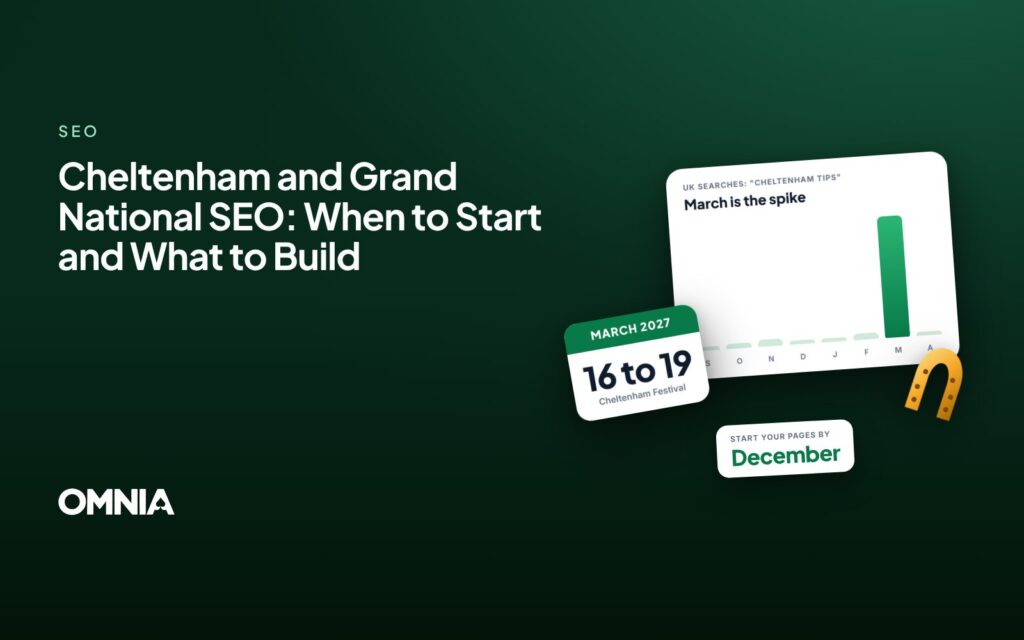
If you want to rank for the Cheltenham Festival, start building your pages in November or December. For the Grand National, start by January at the latest. Search demand explodes in the week of each event, but the pages that win those searches were published, linked and ranking months before.
This guide covers the 2027 dates, how search demand builds, which searches are worth targeting, a month-by-month plan for sportsbooks and betting affiliates and how to get your racing pages cited in AI Overviews and AI answers.
Key dates for 2027
| Event | Dates | Venue |
|---|---|---|
| Cheltenham Festival | Tuesday 16 to Friday 19 March 2027 | Cheltenham Racecourse |
| Cheltenham Gold Cup | Friday 19 March 2027 | Cheltenham Racecourse |
| Grand National Festival | Thursday 8 to Saturday 10 April 2027 | Aintree Racecourse, Liverpool |
| Grand National | Saturday 10 April 2027 | Aintree Racecourse, Liverpool |
Our sportsbook SEO calendar has the full list of racing and sporting dates for 2026 and 2027.
How search demand builds
Racing search is extremely seasonal. UK searches for “cheltenham tips” were around 2,650 in January 2026 and 4,800 in February, then jumped to more than 88,000 in March, the month of the Festival.
September 2025 to April 2026. The Festival was in March.
Source: Ahrefs, UK monthly search volume estimates.
Across the 12 months from April 2025 to March 2026, around three quarters of all UK searches for “cheltenham tips” happened in March alone. The Grand National follows the same pattern a month later, with searches for “grand national tips” rising from around 3,200 in March 2026 to almost 64,000 in April.
Source: Ahrefs, UK monthly search volume estimates.
That spike is the whole opportunity, and it is also the problem. A page published in March has days, not months, to be found, indexed, linked and trusted by Google. By then, the results are already settled.
Searches worth targeting
These are average monthly UK searches from Ahrefs. Because demand is concentrated in one or two months, the real numbers in Festival week are far higher.
| Search | UK searches a month | Difficulty (0 to 100) |
|---|---|---|
| grand national | 60,000 | 60 |
| cheltenham festival | 31,000 | 37 |
| grand national runners | 23,000 | 46 |
| cheltenham tips | 9,500 | 10 |
| grand national tips | 5,800 | 29 |
| grand national odds | 4,100 | 57 |
| cheltenham odds | 1,800 | 41 |
| cheltenham festival tips | 1,600 | 32 |
| cheltenham gold cup odds | 1,300 | 24 |
| cheltenham free bets | 1,300 | 12 |
| grand national free bets | 1,000 | 41 |
| grand national sweepstake | 900 | 0 |
| cheltenham betting sites | 350 | 41 |
| grand national betting sites | 300 | 56 |
Source: Ahrefs, UK, November 2026.
Two things stand out:
- Tips searches are surprisingly easy. “Cheltenham tips” has 9,500 searches a month on average but a difficulty of just 10, so a strong tips hub can realistically compete.
- The Grand National reaches beyond regular bettors. “Grand national runners” and “grand national sweepstake” are searched by people who bet once a year, which makes runner lists, sweepstake kits and simple explainers valuable.
Why you cannot start in March
Every year, brands ask whether they can still rank for Cheltenham with a few weeks to go. Usually the honest answer is no, for four reasons:
- Google needs time to find and index new pages, especially on large betting sites with thousands of URLs.
- Links take time to earn, and links built in the final week look like what they are.
- The top results have history. Pages that have ranked for Cheltenham for years, and been updated each season, carry trust that a brand-new page does not.
- Your team is busy in Festival week. That is the time to update odds and results, not to build pages from scratch.
Our guide on how long SEO takes for a casino or sportsbook explains the timelines in more detail.
What to build
Evergreen hubs that keep their links
The most common mistake is a new page every year, such as /cheltenham-2026/ and then /cheltenham-2027/. Each new URL starts again with no links and no history.
Instead, keep one permanent hub for each event, such as /cheltenham-festival/ and /grand-national/, and update it every season. Every link it earns stays with it, so it gets stronger every year.
Day-by-day and race pages
Under each hub, build pages that match how people search during the event:
- Cheltenham: a page for each day and for the feature races, including the Champion Hurdle on Tuesday, the Queen Mother Champion Chase on Wednesday, the Stayers’ Hurdle on Thursday and the Gold Cup on Friday.
- Grand National: a runners page, an odds page and a page for each day of the Aintree Festival.
Content for once-a-year bettors
The Grand National brings in people who rarely bet at other times of year. Useful pages for them include:
- a printable sweepstake kit, which has almost no competition
- an explainer on each way betting and how places work in a big field
- a simple guide to reading racing odds
Tips and previews with real expertise
Tips content is easy to produce and hard to make credible. Show who wrote it, explain the reasoning and keep a public record of past tips. Google holds betting content to a high standard of trust, as our guide to E-E-A-T for gambling sites explains.
A month-by-month plan
| When | What to do |
|---|---|
| November and December | Update or build the Cheltenham and Grand National hubs, fix internal links and refresh last year’s pages |
| December and January | Start link building and digital PR to the hubs, and publish ante-post and big-race guides |
| January and February | Add trials coverage and early previews for Cheltenham, and publish Grand National explainers and the sweepstake kit |
| Early March | Add day-by-day Cheltenham pages, final previews and free bet pages with clear terms |
| Festival week | Update odds, runners, tips and results daily, and link to everything from your homepage |
| Late March and early April | Switch focus to the Grand National: runners, odds, tips and each way guides |
| After the events | Add results, keep every URL live and plan improvements for next year |
Links and digital PR
Racing content earns links when it gives journalists something new: data on the most backed horses in previous years, Festival trends or local stories around Cheltenham and Aintree. Relevant racing, sports and regional news sites are worth far more than generic placements. Read more about what makes a good gambling backlink and our iGaming digital PR work.
Free bet and offer pages: the rules
“Cheltenham free bets” and “grand national free bets” are valuable searches, but offer pages need care. In the UK, wagering requirements on bonuses have been capped at 10 times since January 2026, and promotions cannot require players to use more than one product, such as betting and casino. Every offer page also needs clear significant terms, 18+ messaging and safer gambling information.
Getting your racing pages into AI Overviews and AI answers
More racing questions are now answered before anyone clicks a link: in Google’s AI Overviews, and in tools like ChatGPT and Perplexity. Getting your pages cited in those answers is often called generative engine optimisation (GEO) or answer engine optimisation (AEO).
Our own research suggests betting is where this matters most. When we tested 20 high-intent UK gambling searches in October 2026, all five AI Overviews we found appeared on betting searches, and none on casino searches. Read the full GEO vs SEO study.
Rank first, because AI Overviews follow rankings
In our study, 95% of the pages cited in Google’s AI Overviews already ranked in the top 10 for the search or a close variant. So everything above still comes first: an evergreen hub, built early, with links pointing at it. A page that is not ranking by Festival week is very unlikely to be cited in an AI Overview either.
Answer the question in the first lines
AI tools pull short, clear answers. Open each section with a direct answer, then add the detail. For example:
- “When is the Cheltenham Gold Cup 2027?” answered with the date and time in the first sentence
- “How does each way betting work on the Grand National?” answered in two or three plain sentences before any example
- “How many runners are in the Grand National?” answered with the number, then the rules behind it
Use the same wording people search for in your headings, and put key facts such as dates, distances and race times in tables, which are easy for AI tools to read.
Keep facts current and consistent
Racing facts change quickly: declarations, non-runners, ground conditions and odds. AI tools are less likely to cite a page that contradicts other sources. Show a visible “last updated” date, check every fact before Festival week and make sure the same date or fact is written the same way across all your pages.
Make your explainers your strongest pages
In our study, bookmakers’ own help pages on topics like each way betting and best odds guaranteed were cited by AI tools even when they were not ranking particularly well. A clear, accurate explainer on each way betting, best odds guaranteed or non-runner rules is one of the most reliable ways into AI answers around Cheltenham and Aintree.
Show real expertise
Name the people behind your tips and previews, explain their experience and keep a public record of past selections. Trust signals matter even more for AI tools, which tend to lean on sources they consider reliable.
Get into the sources chatbots trust
ChatGPT and Perplexity cite a wider range of sources than Google’s AI Overviews. In our study, around half of their citations came from pages that did not rank for the topic, mostly national newspapers, the regulator and affiliate pages. Digital PR that earns your brand a place in national newspaper racing coverage and Festival roundups is one of the most direct routes into those answers.
Let AI crawlers reach your pages
Check that your robots.txt file and security settings do not block the crawlers AI search tools use, such as OAI-SearchBot for ChatGPT search and PerplexityBot for Perplexity. If they cannot reach your pages, they cannot cite them.
Put your content in the HTML, not behind JavaScript
This is one of the biggest technical differences between Google and AI tools, and many betting sites get it wrong.
When Googlebot visits a page, it can render JavaScript. In other words, it runs the page’s code like a browser does and reads the finished result. Google’s AI Overviews draw on that same rendered index.
Most AI crawlers do not. A 2024 analysis by Vercel and MERJ found that none of the major AI crawlers it studied rendered JavaScript, including OpenAI’s crawlers behind ChatGPT and Anthropic’s ClaudeBot. They read the raw HTML the server sends, and nothing that loads afterwards.
That matters because of how many sportsbook and affiliate pages are built. On a lot of sites, the page arrives as an almost empty shell and JavaScript fills in the content once it loads:
- race cards, runners and odds pulled in from a feed
- tips, previews and tables loaded from an API
- content hidden in tabs, accordions or “load more” buttons that only load when clicked
- whole sites built as single-page apps in frameworks like React or Vue, without server-side rendering
A visitor sees a complete page. Google usually sees it too. But an AI crawler may see only a heading, a menu and a footer, so your carefully written Gold Cup preview might as well not exist.
How to check your own pages: open a page, right-click and choose “View page source”, not “Inspect”. Then search for a key fact, such as the race date or a horse’s name. If it is not in the source, most AI crawlers cannot see it either.
How to fix it: ask your developers to render the important content on the server, using server-side rendering or pre-rendering, so it is in the HTML from the start. Live odds can still update with JavaScript on top, as long as the dates, runners, previews and explainers are in the page source. Our technical SEO audits check exactly this.
What GEO cannot do
No one can guarantee that an AI tool will cite your brand, and some tools decline many gambling questions altogether. In our study, Gemini declined eight of our nine chatbot questions. GEO works best as part of a strong SEO strategy, not as a replacement for one.
Get help planning your racing SEO and AI visibility
We help sportsbooks and betting affiliates plan content around the racing and sporting calendar, so their pages are ranking before demand peaks. We can also check where your brand appears in AI Overviews, ChatGPT and Perplexity for your most valuable racing searches, test whether AI crawlers can actually read your pages, show you where competitors are being cited instead and build the content, technical fixes and digital PR to close the gap.
Find out more about our sports betting SEO and iGaming GEO services, or book a free AI visibility check.
FAQs
When should I start Cheltenham SEO?
Ideally in November or December, around four months before the Festival. That gives Google time to index your pages and gives you time to build links before searches peak in March.
When is the 2027 Cheltenham Festival?
Tuesday 16 to Friday 19 March 2027, with the Gold Cup on the Friday.
When is the 2027 Grand National?
Saturday 10 April 2027 at Aintree, at the end of the three-day Grand National Festival from 8 to 10 April.
Should I create a new Cheltenham page every year?
No. Keep one permanent URL for each event and update it every season, so it keeps the links and rankings it has earned.
How do I get my Cheltenham pages into Google’s AI Overviews?
Rank first, because most pages cited in AI Overviews already rank in the top 10. Then answer common questions directly in the first lines of each section, keep facts current and consistent, and show who is behind your tips and previews.
Can ChatGPT read content loaded with JavaScript?
Usually not. Most AI crawlers, including OpenAI’s, read only the raw HTML a page sends and do not run JavaScript. If your race cards, tips or previews load with JavaScript, AI tools may not see them, even if Google does.
Which Cheltenham searches are easiest to rank for?
“Cheltenham tips” and “cheltenham free bets” have low difficulty scores for their search volume, so they are good targets for brands without years of racing authority.
Correct as of November 2026. Search volumes are Ahrefs estimates for the UK. For general information only, not legal advice.