Meta Ads for iGaming: How to Run Casino and Sportsbook Ads on Facebook and Instagram
6 min read Omnia Agency
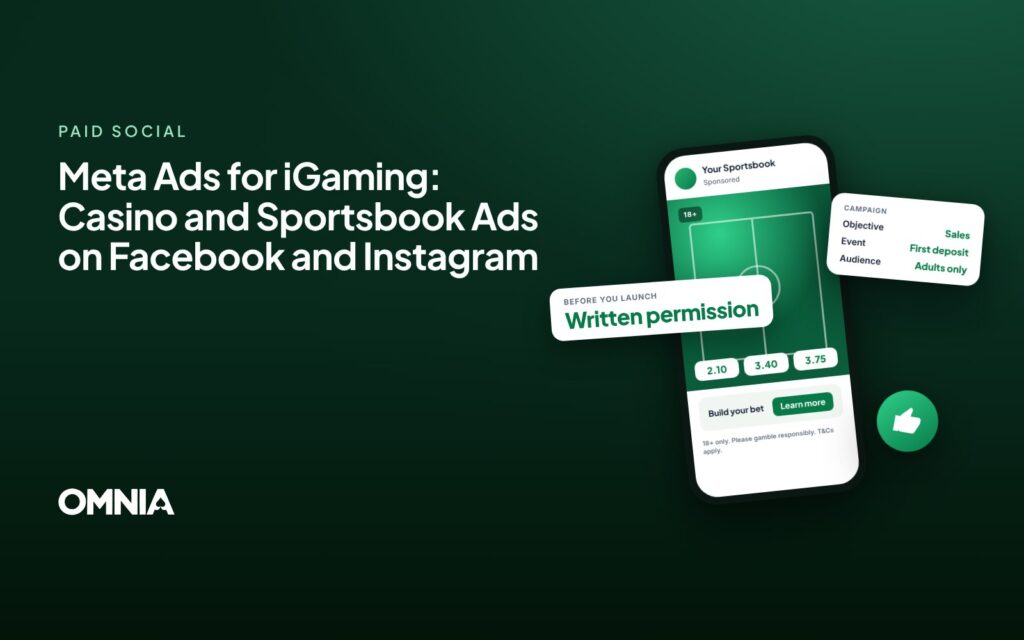
Yes, casino and sportsbook brands can advertise on Facebook and Instagram, but only with Meta’s prior written permission, only in countries where the brand is licensed and only to adults. Once you are approved, Meta Ads work much like they do for any other advertiser, with a few extra rules and a lot more care around audiences, creative and tracking.
This guide covers what you need before you launch, how to structure a campaign, which objectives and audiences to use and how to measure what matters for a gambling brand.
Can gambling brands advertise on Facebook and Instagram?
Meta treats online gambling as a restricted category. To run ads for real-money gambling, including casino, sports betting, poker and lotteries, you need to:
- Apply for Meta’s written permission through its online gambling application form.
- Show that you are licensed, or otherwise legally allowed to operate, in each country you want to target.
- Target only people aged 18 or over, or older where local law requires it, such as 21 in most US states.
Affiliates need permission too if their ads lead to pages that promote real-money gambling. Social casino and free-to-play games, where players cannot win anything of real value, are handled under a separate, lighter policy.
Permission is only the first step. Every ad also has to follow the advertising rules of each market, such as the CAP Code in the UK, so a Meta approval never makes a non-compliant ad acceptable.
What to set up before your first campaign
| Step | Why it matters for gambling brands |
|---|---|
| Meta written permission | Without it, gambling ads are rejected and accounts can be restricted |
| Business Manager | Keeps ad accounts, pages, pixels and team access under one owner |
| Meta Pixel and Conversions API | Records registrations and deposits, including when browsers block tracking |
| Cookie consent | UK and EU visitors must agree before the pixel tracks them |
| Conversion events | Registration and first deposit, so Meta can optimise for real players |
| UTM parameters | Lets you see Meta traffic and sign-ups in your own analytics |
Pixel, Conversions API and events
The Meta Pixel sits on your site and records what people do after clicking an ad. The Conversions API sends the same events from your server, which fills gaps when browsers or ad blockers stop the pixel firing.
For a casino or sportsbook, the events that matter are registration and first deposit. Set them up as conversion events in Events Manager, test them before launch and make sure they only fire once a player has actually completed each step. Meta has also removed the old limit of eight prioritised web events, so you no longer have to rank your events against each other.
Consent and privacy
Under UK and EU data protection law, visitors must be told how their data is used and give consent before the pixel tracks them, usually through a cookie banner. They must also be able to withdraw that consent at any time.
How a Meta Ads campaign is structured
Every Meta campaign has three levels. Getting the structure right makes it much easier to see what is working.
| Level | What you set here | iGaming example |
|---|---|---|
| Campaign | The objective | Sales, optimised for first deposits |
| Ad set | Audience, placements, budget and schedule | UK adults 25 and over, Reels and Stories, Premier League weekend |
| Ad | Creative, copy and landing page | A short video of your bet builder, linking to a compliant offer page |
A common set-up is one campaign per objective, with separate ad sets for each market or audience, so you can move budget towards the segments that bring in depositing players.
Choosing the right campaign objective
Meta has six campaign objectives. The objective tells Meta what to optimise for, and it cannot be changed once a campaign is created.
| Objective | Use it for |
|---|---|
| Awareness | Building your brand around big events, such as a new season or a major tournament |
| Traffic | Sending people to guides, previews or content pages |
| Engagement | Growing video views, page engagement or messaging conversations |
| Leads | Collecting sign-ups for a newsletter or tipster service, where allowed |
| App promotion | Driving installs and in-app events for a sportsbook or casino app |
| Sales | Optimising for registrations and first deposits on your website |
For most operators, Sales is where the budget ends up, because it optimises for the actions that actually make money. Awareness and Traffic are useful for launching in a new market or building interest before a big event.
Audiences for casino and sportsbook ads
Meta offers three types of audience.
Core audiences
These are built from location, age and interests. For gambling, location and age are not just targeting choices but compliance requirements: target only the countries, and in the US the states, where you hold a licence, and set the minimum age to the legal limit or higher. Some operators choose a higher minimum, such as 25, to further reduce the risk of reaching younger people.
Custom audiences
These are people who have already interacted with you, such as website visitors, app users or customers whose details you have permission to use for marketing. Custom audiences are powerful for retargeting, but in gambling they need careful handling. Always exclude players who have self-excluded, closed their account for gambling reasons or opted out of marketing, and keep those exclusion lists up to date.
Lookalike audiences
These are new people who share characteristics with an audience you already have. A lookalike built from depositing players is usually far more useful than one built from all website visitors. Meta lets you choose how closely the lookalike matches, from 1% (closest) to 10% (broadest).
Meta is also leaning more on broad targeting through its Advantage+ tools, where the algorithm finds the audience for you. This can work well for gambling brands, but only inside the age and location limits you set.
Creative and placements
Most gambling ads now run in Reels, Stories and the mobile feed, so plan creative as vertical video first. Short clips that show the product, such as a bet builder, live odds or a game in action, usually explain more in five seconds than a static banner.
Gambling creative also has to follow the rules of each market. In the UK, for example, ads must not have strong appeal to under-18s, must not suggest gambling can solve money problems and must make significant offer terms clear. Bonus advertising is restricted in some markets, such as Ontario and Alberta, so an offer-led ad that works in one country can break the rules in another.
Tracking and measuring results
Use UTM parameters on every ad
UTM parameters tell your analytics where each visit came from. A simple, consistent naming system makes reporting much easier.
| Parameter | Example | What it tells you |
|---|---|---|
| utm_source | The platform | |
| utm_medium | paid_social | The type of traffic |
| utm_campaign | pl_weekend_sales | The campaign |
| utm_content | betbuilder_video_v2 | The specific ad or creative |
The metrics that matter
Likes and shares are nice, but they do not pay the bills. For gambling brands, focus on:
- Cost per registration, to see how efficiently you are bringing in new accounts
- Cost per first deposit, the clearest measure of real acquisition
- Click-through rate, to judge whether your creative is working
- Frequency, so the same people do not see the same ad too often
- Player value over time, from your own data, because the cheapest depositors are not always the most valuable
Meta’s reporting and your own analytics will rarely match exactly. Use Meta for optimising campaigns, and your own data for judging what each channel is really worth.
How paid social supports SEO
Paid social and SEO work best together. Ads around big events can bring in players while new pages are still building rankings, and people who see your ads often search for your brand name later, which shows up in your organic traffic. Meanwhile, the pages that rank well organically make good landing pages for ads.
If you want help running Meta Ads for a licensed gambling brand, see our gambling paid social services, including casino paid social and sports betting paid social, or book a free consultation.
FAQs
Can you advertise gambling on Facebook?
Yes, but only with Meta’s prior written permission, only in countries where you are licensed or legally allowed to operate and only to people aged 18 or over, or older where local law requires it.
Do gambling affiliates need Meta’s permission?
Yes, if their ads lead to pages that promote real-money gambling. Free-to-play and social casino games follow a separate policy.
Which Meta campaign objective is best for a sportsbook?
Sales, optimised for registrations or first deposits, is usually the main objective. App promotion suits sportsbooks with a mobile app, and Awareness can help around big events or market launches.
Can you retarget website visitors with gambling ads?
Yes, with consent to track them, but you must exclude self-excluded players and anyone who has opted out of marketing.
Do Instagram gambling ads follow the same rules as Facebook?
Yes. Instagram ads are run through the same Meta Ads Manager and follow the same advertising policies.
Correct as of November 2026. Meta’s policies and each market’s advertising rules change often, so check the latest versions before launching. For general information only, not legal advice.